
What is the price of gold?
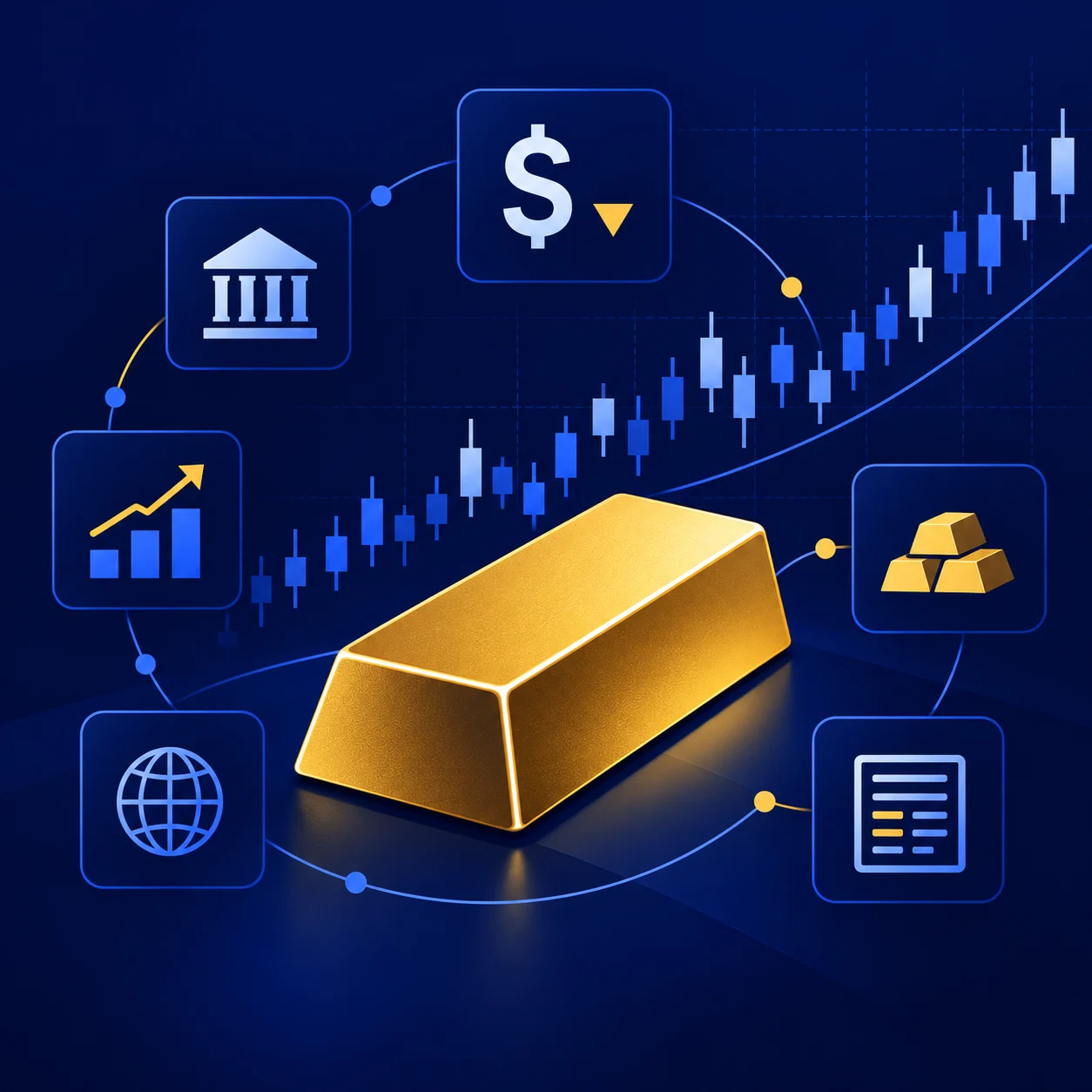
The price of gold is the market value of one troy ounce of gold, quoted in US dollars. Traders see it as the symbol XAU/USD on MetaTrader 5, where XAU is the code for gold and USD for the US dollar.
The benchmark price changes every second during trading hours, as buyers and sellers around the world react to news, data and each other.
1. Why does gold move against the US dollar?
Gold usually rises when the US dollar weakens, because it becomes cheaper for buyers who pay in other currencies. When the dollar strengthens, the same ounce costs more in euros, Turkish lira or Egyptian pounds, which can reduce demand.
This link is strong but not fixed. In periods of crisis, gold and the dollar can rise together as investors look for safety in both.
2. How do interest rates affect gold?
Higher interest rates tend to weigh on gold, because gold pays no interest while savings and bonds do. When rates rise, holding gold has a higher “opportunity cost”.
What matters most is the real interest rate: the interest rate minus inflation. When real rates fall or turn negative, gold often becomes more attractive. This is why decisions by the US Federal Reserve are among the biggest events for gold traders.
3. Does inflation push gold higher?
Inflation can support gold, because many people buy it to protect the value of their savings when prices rise. This is especially true where local currencies lose value quickly, as many families in our region know well.
The effect is not immediate. If central banks answer inflation with higher interest rates, the rate effect can outweigh the inflation effect for a time.
4. Why do central banks buy gold, and how much?
Central banks buy gold to diversify their reserves away from any single currency and to hold an asset no other country controls. Their buying has become one of the strongest supports for gold.
According to the World Gold Council, central banks bought 1,092 tonnes in 2024 and 863 tonnes in 2025. Even the lower 2025 figure was far above their 2010 to 2021 average of 473 tonnes a year.
5. How does global uncertainty affect gold?
Gold tends to rise when fear rises, because investors see it as a store of value that does not depend on any government or company. Wars, political crises, banking stress and market crashes can all send buyers to gold.
These moves can be fast and can reverse just as quickly once the fear fades.
6. How does investor demand move the gold price?
Large flows of investment money, especially into gold exchange-traded funds (ETFs), can push the price up or down. In 2025, investment demand reached 2,175 tonnes, up 84% on the year, and holdings in gold ETFs grew by 801 tonnes (World Gold Council).
That same year, the gold price set 53 new all-time highs, and its annual average reached US$3,431 per ounce, up 44% (World Gold Council, LBMA PM price).
7. Do jewelry demand and mine supply matter?
Jewelry demand and mine supply matter over the long term but rarely drive day-to-day moves. High prices can reduce jewelry buying: in 2025, jewelry fabrication fell 19% to 1,638 tonnes, while its total value rose to a record US$172 billion (World Gold Council).
Mine supply changes slowly, because new mines take many years to open, so it seldom explains short-term price swings.
How do these drivers show up when you trade XAU/USD?
You see these drivers most clearly around scheduled news. A practical routine on MetaTrader 5:
- Add XAU/USD to Market Watch and open a chart.
- Check the economic calendar for US inflation (CPI), the monthly US jobs report and US Federal Reserve rate decisions.
- Watch the spread before and after big releases; it can widen when volatility rises.
- Decide your stop loss and position size before you open a trade, not after.
- Practice this routine on a free demo account before trading with real money.
What are the risks of trading gold?
Gold can move several percent in a single day, and leverage makes those moves larger in your account, in both directions. Prices can also jump past your stop loss during fast markets or at the weekly open.
Trading the gold price is not the same as owning physical gold: you do not hold any metal, and overnight financing may apply. Only trade money you can afford to lose. Read our risk management guide.
Frequently asked questions
Why is gold priced in US dollars?
The global gold market has used the US dollar as its main pricing currency for decades, and the main benchmark prices are set in dollars. Prices in other currencies are converted from the dollar price.
Does gold always rise when the dollar falls?
No. The two often move in opposite directions, but not always. In a crisis they can rise together, and other drivers such as interest rates can outweigh the dollar effect.
Why do central banks buy gold?
To diversify their reserves and hold an asset that carries no credit risk from any other country. According to the World Gold Council, central banks bought more than 1,000 tonnes a year from 2022 to 2024, and 863 tonnes in 2025.
When does the gold price move most?
Gold is usually most active during the London and New York trading sessions, and around major US data releases and Federal Reserve decisions.
Is gold a safe investment?
No investment is free of risk. Gold has a long history as a store of value, but its price can fall sharply, and trading it with leverage adds further risk.
Sources
- World Gold Council, Gold Demand Trends: Q4 and Full Year 2025, 29 January 2026.
- World Gold Council, Gold Demand Trends Full Year 2025: Central Banks, 29 January 2026.
- World Gold Council, Gold Demand Trends Full Year 2025: Investment, 29 January 2026.
- World Gold Council, Gold Demand Trends Full Year 2025: Jewellery, 29 January 2026.
- World Gold Council, Gold Demand Trends Full Year 2025: Supply, 29 January 2026.
Educational content, not investment advice. Trading with leverage carries a high risk of losing money rapidly.